THE DAY THAT FROZE THE NATION
It was January 28, 1986 — a bitterly cold morning at the Kennedy Space Center in Florida. Millions of Americans, including thousands of schoolchildren, tuned in live to watch the Space Shuttle Challenger lift off.
Onboard were seven astronauts — pioneers, dreamers, and heroes:
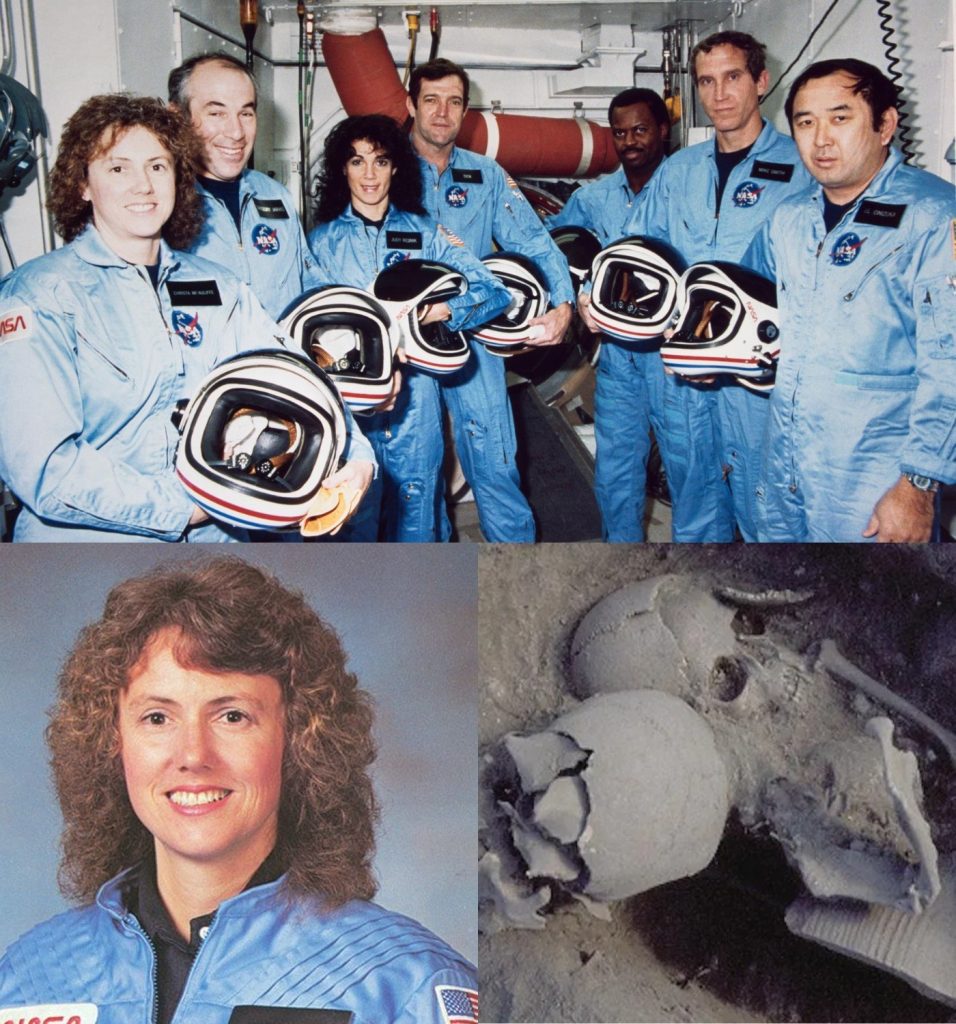
- Francis R. “Dick” Scobee, Commander
- Michael J. Smith, Pilot
- Ronald McNair, Mission Specialist
- Ellison Onizuka, Mission Specialist
- Judith Resnik, Mission Specialist
- Gregory Jarvis, Payload Specialist
- Christa McAuliffe, the first civilian teacher ever chosen for space
As the shuttle roared upward, the nation cheered. Teachers paused lessons to let students watch. Then—73 seconds later—the screen filled with white fire. The Challenger disintegrated before the eyes of the world.
What followed was disbelief, horror, and a question that haunted NASA and the nation for decades:
What happened to the crew?
THE TRUTH NASA STRUGGLED TO FACE
For years, many believed the explosion had instantly killed all seven astronauts. But the reality, revealed through later investigations, was far more tragic — and haunting.
The Challenger didn’t actually explode in the traditional sense. A faulty O-ring seal in the right solid rocket booster allowed hot gases to escape, burning through the external fuel tank. The orbiter didn’t blow apart; it broke up under extreme aerodynamic stress.
Inside the crew cabin — the strongest and most intact part of the shuttle — the seven astronauts were still strapped into their seats.
The crew compartment was blasted away from the main shuttle body, and though badly damaged, it remained structurally intact as it fell more than 65,000 feet into the Atlantic Ocean.
NASA later confirmed: the crew likely survived the initial breakup.

THE TERRIFYING FINAL SECONDS
Experts determined that several of the crew’s emergency oxygen packs had been activated, suggesting that some astronauts were conscious after the disintegration.
According to the official Rogers Commission report, evidence showed that pilot Michael J. Smith’s oxygen unit had been switched on manually. So had those of Resnik and Onizuka.
That meant at least three crew members were alive — possibly alert — as the cabin plunged helplessly toward the ocean for nearly two and a half minutes.
The cockpit data recorder went silent after the breakup, so no voices were ever recovered. But investigators concluded that the crew may have been aware of their fate as the module fell at terminal velocity toward the sea.
Impact with the ocean — at over 200 mph — was catastrophic. NASA described it as “a non-survivable event.”
THE RECOVERY THAT NO ONE WANTED TO SEE
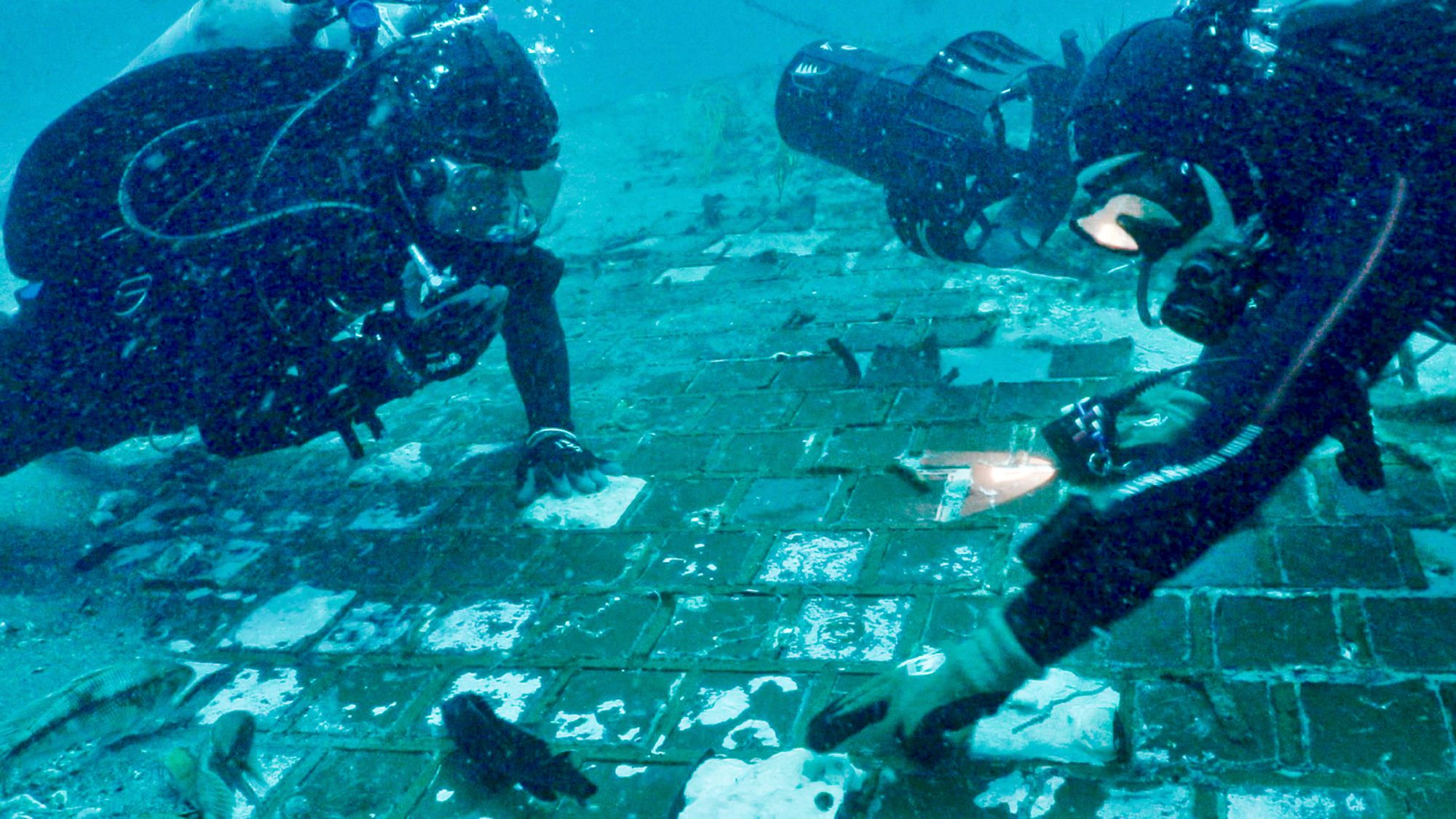
For weeks after the tragedy, Navy divers and recovery teams scoured the Atlantic off the coast of Cape Canaveral. Wreckage was scattered across more than 100 square miles of ocean.
But on March 9, 1986, nearly six weeks after the disaster, a sonar scan picked up something large and solid beneath the waves.
It was the crew cabin.
At a depth of nearly 100 feet, divers found the remains of the compartment — mangled but recognizable. Inside, they discovered what NASA officials would only describe as “crew remains.”
Recovery operations were conducted with utmost secrecy and dignity. The bodies, badly disfigured by the impact, were carefully placed in sealed containers and flown to a secure facility at Patrick Air Force Base.
NASA never released specific details about the condition of the remains — out of respect for the families.
THE HEARTBREAKING RETURN HOME
In April 1986, the remains of the Challenger crew were returned to their families. Each was identified through careful forensic analysis — a process that took weeks.
NASA employees who handled the recovery described the atmosphere as “unbearably quiet.” One diver later said,
“We weren’t bringing up astronauts. We were bringing up heroes.”
The crew were interred with full honors.
Six of them — Scobee, Smith, McNair, Onizuka, Resnik, and Jarvis — were buried at Arlington National Cemetery in a shared memorial grave overlooking the Potomac River.
Christa McAuliffe, the beloved teacher whose dream inspired millions, was laid to rest separately in her hometown of Concord, New Hampshire.
At her funeral, her students placed seven apples on her casket — one for each member of the Challenger crew.
NASA’S LONG NIGHT OF THE SOUL
The Challenger disaster shook NASA to its core. A culture of overconfidence and schedule pressure had ignored repeated warnings from engineers who begged leadership to postpone the launch due to freezing temperatures.
The haunting truth was that the accident was preventable.
The O-ring flaw in the rocket boosters had been identified years earlier — but never corrected. When engineers at Morton Thiokol, the company that built the boosters, tried to stop the launch, NASA managers overruled them.
The cost of that decision was seven lives and the death of America’s space innocence.
THE LEGACY THAT ENDURED
Despite the tragedy, the spirit of the Challenger crew never died.
The Challenger Center for Space Science Education, founded by the astronauts’ families, continues to this day — teaching millions of children about science, space, and courage.
Each year, NASA honors the fallen with Remembrance Day, reading aloud their names and stories.
And at Kennedy Space Center, near Launch Complex 39B, a memorial plaque bears the words:
“They slipped the surly bonds of Earth to touch the face of God.”
THE QUESTION THAT STILL ECHOES
So, what happened to the bodies of the Challenger crew?
They were found, laid to rest with honor, and remembered forever. But their legacy reaches far beyond the ocean where they fell.
Every time a rocket lifts into the sky, it does so on the lessons learned from their sacrifice.
Every young astronaut who dreams of reaching the stars carries a piece of their courage.
And every teacher, every student who looks up at the night sky, remembers that seven heroes once did the same — and dared to go higher