Kinsley’s Honor Walk: A Story of Love, Loss, and LegacyPauseUnmute
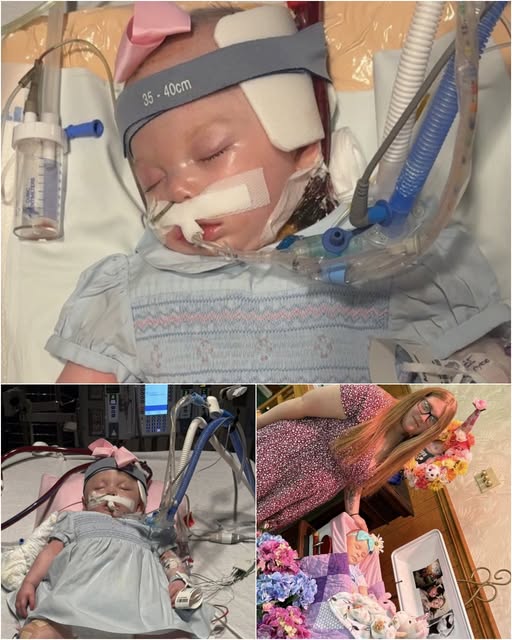
The decision no parent ever wants to face came far too soon for Kinsley’s family. Their little girl, with her delicate fingers and angelic face, lay quietly in her hospital bed, machines keeping her tiny chest rising and falling. To anyone who looked from the outside, she might have seemed like she was simply sleeping. But the truth was far heavier. Kinsley’s heart continued to beat, strong and steady, but her brain was silent. The doctors explained, with tears in their eyes, that there was no activity, no chance of recovery. Their precious daughter had already gone home, leaving only her fragile body behind.
It was in that moment, in the thick of unimaginable pain, that Kinsley’s parents were asked a question that would define their child’s legacy: Would they consider donating her organs so that other children could live?
The room fell silent. The weight of grief pressed down on them, and yet, through the fog of sorrow, a light flickered. Their little girl had been a fighter, radiating love and strength even in her short life. Could it be that her story wasn’t ending here, but continuing through others?
They said yes.

That night, the hospital prepared for what is known as the honor walk. Nurses and doctors lined the hallways. Families of other patients stood quietly, some with hands folded, some with tears streaming down their faces. Each person there recognized the sacredness of the moment—the courage of a family willing to give when they had already lost so much.
As the doors opened, Kinsley’s bed began to roll slowly down the long hallway. Her parents walked beside her, holding her hands, whispering their love. The sound of muffled sobs echoed, but so did something else: respect, gratitude, and reverence. Each step down that hallway was both heartbreak and hope intertwined.
Kinsley’s honor walk was not only about the life she had lived, but the lives she was about to touch. Somewhere, another family was waiting by a phone call, praying for a miracle. Somewhere, a mother sat at her child’s bedside, hoping today would not be their last together. Somewhere, a little boy or girl would receive the gift of life because of Kinsley.

Sixty-seven days.
That is how long it has been since Kinsley took her last breath. Yet, her family says, her presence is everywhere. They feel her in the sunlight streaming through the windows, in the quiet moments when the house is still, in the way their hearts ache and yet somehow keep beating.
They remember her laughter, high-pitched and sweet, filling rooms with joy. They remember her tiny hands clutching toys, her eyes sparkling when she looked up at them. They remember the way she fought—through hospital stays, through the beeping machines, through the endless tests. Kinsley never gave up. And in many ways, she still hasn’t.
Her parents often whisper that her fight continues, not through her body, but through the lives she saved. Each time they hear from the transplant team, updates about the children who received her gifts, they feel her presence again. A child now breathes easier because of her lungs. Another’s heart beats stronger because of hers. Families who once stood on the brink of despair now cling to new beginnings—all because of Kinsley.

The grief, however, does not fade quickly. There are days her parents can hardly get out of bed, the weight of her absence pressing heavily on their shoulders. There are nights they wake from dreams where she was still alive, only to be met with the emptiness of her room. But even in the midst of their sorrow, they hold onto one truth: Kinsley’s life mattered.
She was more than her illness, more than her final days in a hospital. She was a daughter, a sister, a granddaughter, a friend. She was a soul who brought light to everyone she met. And now, she is a guardian angel for families who once stood where her parents stand.
The honor walk has become a memory etched forever in their hearts. They recall the faces of strangers who wept for their daughter, the quiet hush as she was wheeled past, the way time seemed to stand still in that hallway. For those few minutes, the world recognized Kinsley’s courage and their family’s sacrifice. It was a goodbye, but also a beginning.
In the days that followed, letters began arriving. Messages from families who had been touched by organ donation. Words of gratitude from people who had never met them but who now carried a piece of Kinsley’s legacy in their lives. One mother wrote, “Because of your little girl, my son will see his next birthday. We will never forget her.”
Kinsley’s parents keep those letters in a box, opening them when the grief feels unbearable. Each word reminds them that their child’s story is not one of tragedy alone, but of love that outlives even death.

Her absence is felt in every corner of their home. Her toys remain where she last left them. Her clothes still carry her scent. Photographs line the walls, capturing her in moments of laughter and play. And though tears often fall as they pass by those memories, there is also a quiet pride: pride that their daughter, in her short time, accomplished something extraordinary.
Not everyone gets to leave a legacy. But Kinsley did.
On days when grief is too heavy, her parents walk outside and look at the sky. They imagine her among the stars, watching over them, guiding them, whispering that she is okay. They imagine her smiling as she sees the children who now live because of her gift. And though they ache to hold her again, they know she is not truly gone.
Kinsley’s story is now woven into the lives of others. It is present in every heartbeat saved, in every laugh that echoes in a hospital hallway because a child got a second chance. Her family often says, “She is not here in our arms, but she is everywhere around us.”
And so, they continue. They continue to tell her story, to honor her fight, to carry her memory. They continue to grieve, but also to celebrate. Because while her days on earth were too short, her impact is everlasting.

Tonight, as the family lights a candle in her memory, they whisper the same words they whispered that night of her honor walk:
“We love you. We are proud of you. And your fight lives on.”