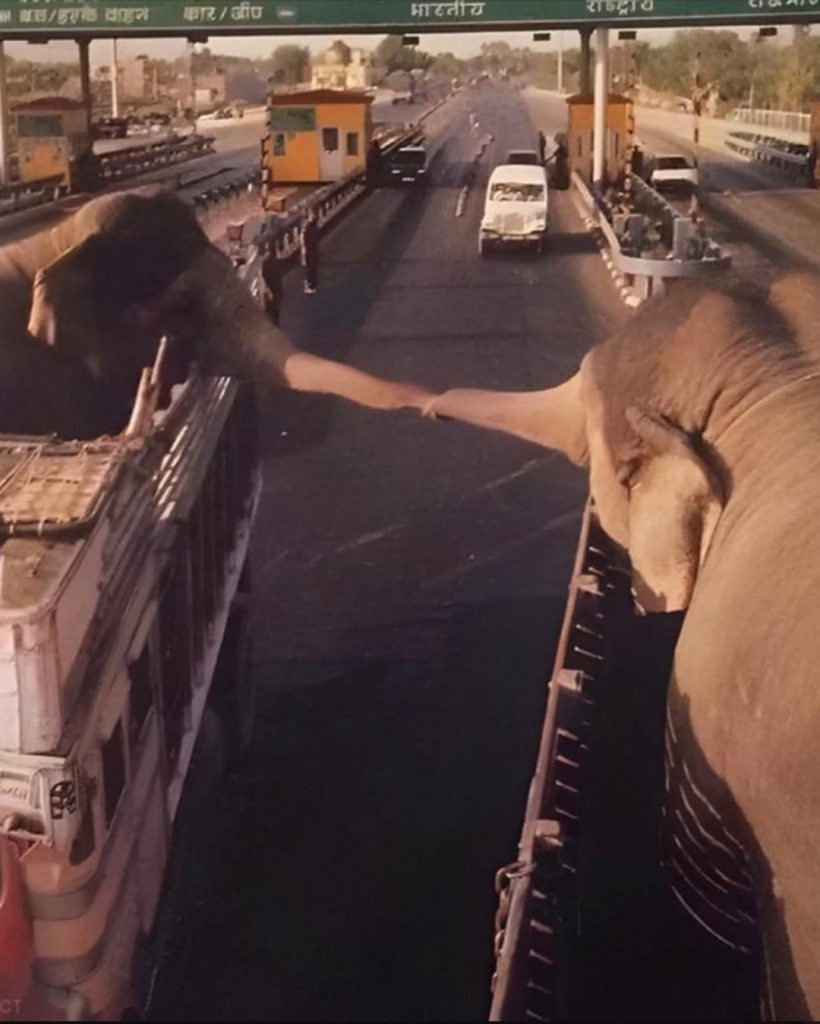
In 2016, on a busy highway in India, a photograph captured a moment that would touch hearts across the world: two elephants entwined their trunks in a silent embrace. It was a gesture of intimacy, a farewell between companions who had been inseparable, yet were about to be separated by human hands—tourism, services, exploitation, or industrial encroachment. That single image spoke volumes: it was a testament to the intelligence, emotion, and deep social bonds of these magnificent creatures.

Elephants are often called “gentle giants,” but this description only scratches the surface of their complexity. They are masters of emotion and social organization, living in family units that are among the most sophisticated in the animal kingdom. Each herd is typically led by a matriarch, a wise and experienced female whose memory and decision-making shape the survival of the group. Within these tight-knit families, every elephant has a role: mothers care for calves, older siblings assist in protection, and the elders hold vital knowledge about migration routes, water sources, and survival strategies. Life for elephants is communal; knowledge, love, and care are passed from one generation to the next.
For young elephants, the world is both a classroom and a playground. Calves are nurtured not only by their mothers but also by other adult elephants in the herd. They learn which plants are edible, how to navigate treacherous terrain, and how to read subtle cues in the behavior of others. They also learn about emotion. An elephant calf watching its mother respond to threats or comfort a distressed herd member is absorbing lessons about empathy, cooperation, and resilience. This learning is not just instinct—it is culture, passed down across generations in the language of touch, sound, and movement.

When elephants are forcibly separated from their families, the impact is profound. Their grief is real, visible, and deeply moving. Scientists have documented elephants standing vigil over the bodies of deceased companions for weeks, refusing to leave the side of a lost friend. They trumpet in distress when a calf is captured, sometimes breaking into a mournful wail that echoes across the forest. These behaviors reveal that elephants feel loss and sadness in ways remarkably similar to humans. Their social bonds are not superficial; they are built on mutual support, care, and emotional recognition.
The story of the two elephants on that Indian highway illustrates this truth vividly. Though the photograph shows a single moment—a trunk wrapped around another, a gentle press of heads—it represents a lifetime of shared experiences, trust, and familial bonds. These elephants had known each other, played together, and supported one another, and now faced an uncertain future. Their embrace was not a casual gesture; it was a farewell, a wordless acknowledgment of the bond they had forged and the pain of imminent separation.
Human activity has become one of the greatest threats to elephants worldwide. Expanding cities, highways, tourism industries, and deforestation have fragmented habitats, forcing elephants into increasingly confined spaces. Conflicts between humans and elephants often result in tragic consequences: young calves are captured, adults are killed or injured, and social structures are disrupted. The emotional toll on the animals is immense, yet largely invisible to those who encounter them from a distance. When an elephant loses a companion or is removed from its herd, it is not just a loss of family—it is a disruption of memory, culture, and the intricate web of social knowledge that ensures survival.
Despite these challenges, elephants display remarkable resilience. Herds adapt to changing environments, teach new generations to navigate dangers, and maintain bonds even after traumatic events. They are capable of joy, play, and even humor. Young elephants frolic, wrestle, and explore with an enthusiasm that is contagious, reminding observers that life, even amidst adversity, can be vibrant. They are also capable of profound compassion, often helping injured or distressed members of other herds, demonstrating that empathy extends beyond immediate family units.
Conservationists and animal behaviorists emphasize the importance of understanding elephants not merely as animals, but as sentient beings with emotional depth. Protecting elephants is not only about preserving a species; it is about respecting the social and emotional worlds they inhabit. Efforts to prevent habitat loss, limit human-wildlife conflict, and rehabilitate rescued elephants are critical. Every intervention that considers the emotional needs of elephants, from allowing social reunions to ensuring access to water and grazing, can mean the difference between despair and well-being.
The image of the two elephants entwined on that Indian highway is a reminder that their lives are complex and meaningful. It calls on humanity to recognize that the choices we make—to build, to exploit, or to conserve—directly affect these intelligent, emotional beings. Their capacity for love, grief, and joy mirrors our own, and in this reflection, we find both a warning and an inspiration: the natural world is alive with feeling, and our actions carry moral weight.
In the end, elephants teach us about connection. They teach us that family is not just about proximity, but about care, attention, and shared experience. They teach us that grief is real, and that mourning is a powerful testament to love. And they teach us that even in the face of separation and loss, bonds formed through trust and affection endure. The embrace of those two elephants on a highway in India remains more than an image; it is a story, a lesson, and a plea—a plea for recognition, respect, and protection of a species that shares our capacity for deep emotion.
As humans, we can choose to honor this lesson. By preserving habitats, supporting ethical tourism, and advocating for elephant welfare, we acknowledge that these majestic creatures are more than wildlife—they are family, culture, and history embodied in living form. And in doing so, we keep alive the hope that elephants, and the bonds they cherish, will survive and thrive for generations to come.