Ryder’s Fight — The Little Boy Who Faced the Same Monster That Took His Aunt
When Kelly first held her baby boy in her arms, she never imagined how fragile life could be.
Ryder was perfect — 10 months old, just learning to crawl, full of curiosity and giggles.
His big sister, three-year-old Charlise, adored him. Their days were simple and happy, filled with laughter and the small chaos of family life after months of isolation during the COVID lockdowns.
But just as Kelly was preparing to return to work after maternity leave, something began to change.
Ryder wasn’t himself.

The First Signs
At first, it was nothing alarming — a little cough, some tiredness. Babies got sick all the time.
But then his face seemed… different.
One eye wouldn’t close when he cried. His smile — once wide and even — began to droop slightly on one side.
Kelly’s heart sank.
She remembered her sister — diagnosed with a brain tumour at two, gone by seven.
The fear that had lived quietly in the back of her mind for years suddenly became impossible to ignore.
When their doctor saw the videos of Ryder’s face, his expression changed.
“This isn’t normal,” he said. “Go to the hospital — and don’t leave without a scan.”
That sentence would change their lives.

The Diagnosis
Within hours of arriving, everything moved fast.
An MRI. Then another. Then the words every parent dreads: “It’s a tumour.”
Kelly’s world collapsed.
She remembered being ten years old, watching her mother go through this with her sister.
Now she was the mother — and her baby was the one fighting to survive.
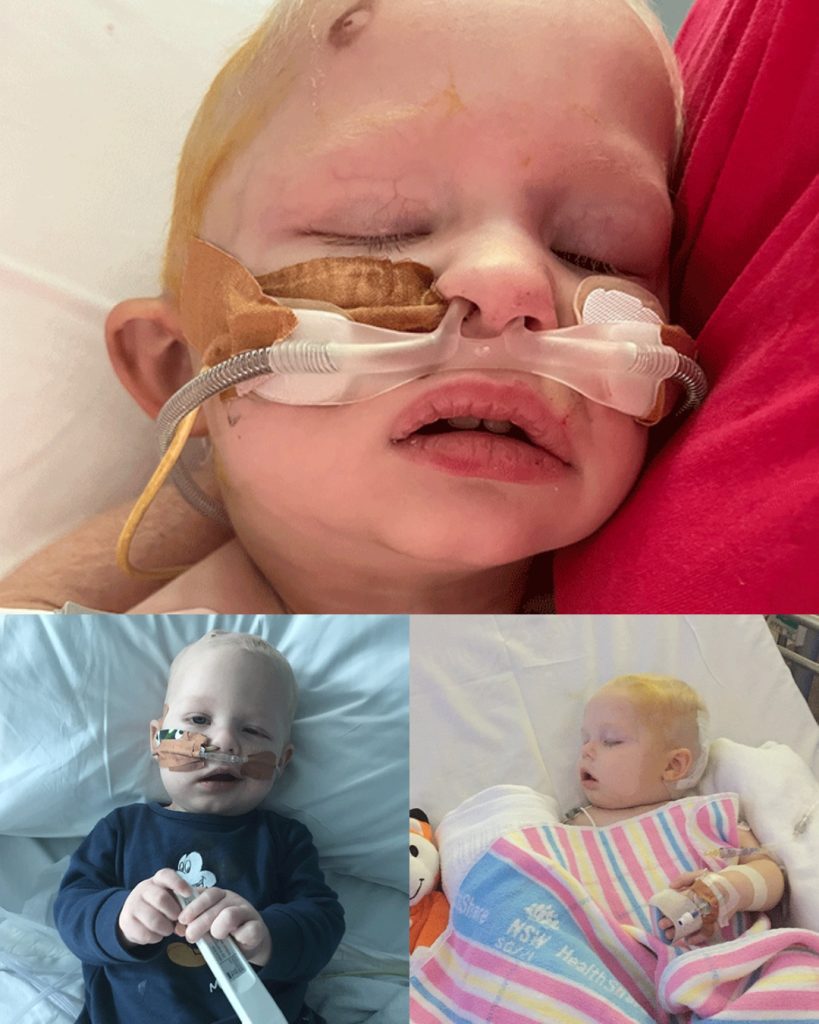
Ryder was transferred to the neurosurgical ward at a children’s hospital. A team of doctors and surgeons explained what they could, but the words blurred together: brainstem, biopsy, high risk.
All Kelly could think was, “Oh no. It’s happening again.”

Surgery and Shock
Ryder underwent emergency surgery to remove part of the tumour and relieve pressure on his brain.
But it wasn’t simple. The tumour was wrapped around vital nerves — too close to the brainstem to remove completely.
“They said it was in a bad spot,” Kelly recalls. “We couldn’t do too much without risking lifelong damage.”
The surgery left Ryder with vocal cord palsy. He could no longer swallow on his own.
For two long years, he was fed entirely through a tube. His parents spent months teaching him to eat again, with the help of feeding specialists.
“He just didn’t know how to swallow anymore,” Kelly says. “He had to relearn everything.”

The Truth Behind the Tumour
When test results came back from the Zero Childhood Cancer Program, the answer was devastating.
Ryder had Atypical Teratoid/Rhabdoid Tumour (AT/RT) — a rare, fast-growing brain cancer caused by a genetic mutation.
That same mutation had likely been the cause of Kelly’s sister’s death decades earlier.
Only now did doctors have a name for it.
“I wish I’d known,” Kelly says quietly. “I wish someone had told us back then that it could be genetic.”
Her daughter Charlise was immediately tested. The results brought a fragile relief — she didn’t carry the mutation.
The Fight of His Life
Ryder began chemotherapy right away — months of intense, grueling treatment.
Most of that first year was spent in hospital rooms. Kelly and Ryder would go home for only a few days before being admitted again when the fevers, infections, or nausea returned.
“He got so sick,” Kelly says. “The chemo was brutal.”
At just 14 months old, he also began radiation therapy — five days a week, for six weeks.
Doctors hesitated, fearing long-term side effects, but there was no choice. The tumour was aggressive; waiting wasn’t an option.
“We thought, if we make it that far, we’ll deal with side effects later. Right now, we just need to keep him alive.”

The Toll on a Family
While Kelly stayed with Ryder in the hospital, Alan and little Charlie stayed nearby at Ronald McDonald House.
There were months when Charlie barely saw her brother.
Kelly understood the ache too well — she’d lost her own sister to cancer.
“I really feel for Charlie,” she says. “I know what it’s like to be the sibling left waiting, watching, not understanding why everything is falling apart.”
Kelly’s mother, too, was reliving her worst nightmare — the same battle, another generation.

A Ray of Hope
Months passed. Slowly, the scans began to show something miraculous — the tumour was shrinking.
In February 2023, doctors attempted a second surgery, this time hoping to remove what was left.
The results were better than anyone dared hope.
What they removed was dead tissue.
For the first time, Kelly allowed herself to breathe.

The Next Chapter
By mid-2023, Ryder’s chemotherapy was finished. To reduce the risk of the cancer returning, the Zero team recommended a targeted therapy — an experimental drug called Tazometastat. He took it for a year, under careful supervision.
“Even though we wanted to give him a break, it was comforting knowing he was still getting treatment,” Kelly explains. “It gave us hope that it was keeping the cancer away.”
They began taking things three months at a time — one scan, one sigh of relief, one day closer to normalcy.


Today
Ryder is now a lively, energetic little boy making up for lost time.
His smile — once uneven from the facial palsy — is bright and full again.
He eats on his own, runs after his sister, and fills the house with laughter.
Every three months, he still has his kidneys checked for possible side effects of treatment. But so far, every result has been clear.
“He’s a very happy kid,” Kelly says, smiling. “I think we can all learn something from him.”
After years of fear, exhaustion, and sleepless nights, their family is finally rediscovering joy.
Ryder’s journey has changed them forever — not just because he survived, but because he showed them what strength truly looks like.
A 10-month-old baby who faced a giant — and won.
And for Kelly, whose sister’s story once ended in heartbreak, this time the story is different.
This time, love and science worked together to rewrite the ending.
Ryder’s still here. Still smiling. Still fighting — and still reminding the world that miracles do happen.